Hard Times
Read Hard Times by Charles Dickens over the holidays. Whilst I thoroughly enjoyed it, I don't consider it amongst my favourites of Dickens' novels. On a personal note, I was glad to have the stamina to read a classic and that my focus hasn't been entirely sapped by smartphones and the internet.
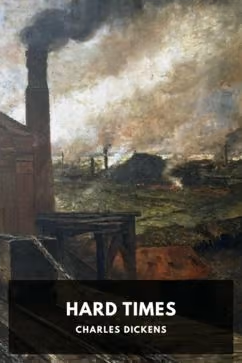
The book is set in the fictional industrial town of Coketown in the north-east of England and revolves around the factory owner, Mr. Bounderby; the utilitarian schoolmaster, Mr. Gradgrind, and his family; and an honest hand at the factory, Stephen Blackpool. Times are hard for everyone, though in different ways. Mr. Bounderby legitimizes his status and treatment of the workers by mythologizing himself in every breath and creating a ridiculous and false rags-to-riches story. Mr. Gradgrind, so committed to a utilitarian approach to education and life, deprives himself and his family of feeling and emotion. Blackpool, though honest and hardworking, becomes ostracized from the workers, wrongfully accused of robbery, and dies after falling into a dangerous disused mine shaft. The fatalistic plotlines reminded me of Thomas Hardy, as characters seemed doomed from the start.
Dickens succeeds in satirizing Bounderby and Gradgrind, and through them the utilitarian philosophy they represent, though fails to grapple with the economic and class relations that led to such hard times for all. Dickens was a reformist and his writing was his activism: he thought that through storytelling he'd change society. If we felt how Stephen Blackpool felt, we'd improve the lives of factory workers. Dickens attributed hard times to personal or idiosyncratic failings of factory owners, which could be remedied by moral suasion. He wasn't a Marxist, and didn't connect the hard times, and moral failings, to class interests and class morality, and the economic structure of the industrial town.
I can't end without mentioning Mr. Sleary and the travelling circus, the antidote to Gradgrind and Bounderby. They are, perhaps, the only characters who aren't emotionally or morally diminished by hard times, though they experience material hardship. They aren't formally educated by Gradgrind's standards but they have their fancies - their imagination, silliness, affection and feeling - which we shouldn't forget to value in our own lives.
I obtained my copy of the book through Standard Ebooks, a volunteer project to create beautiful digital editions of public domain books.