Mechanical analogy for qubit measurement
I have designed (but not yet built) a toy to illustrate measurements of a qubit state on \(x\)-, \(y\)- and \(z\)- axes. You place a ball into this system of pipes. To perform a measurement on an axis, you tilt the board. Under gravity, it rolls along the pipe, hits a fork and with approximately equal probability goes left or right, along another pipe and into a small trap.
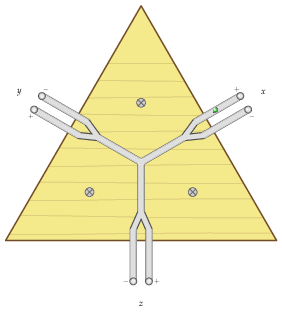
When you make a repeat measurement, by resetting the board to the level position and tipping it the same way, you get the same outcome, as the ball is trapped.
When you perform a new measurement on a different axis, the ball is elevated above level, escapes the trap, rolls to the center, rolls down the next axis, and again goes randomly into one of two traps after hitting a fork.
This shows several features of a qubit system: there are two possible outcomes for any given axis; a measurement is performed in a chosen basis; changing the basis and performing a new measurement does not preserve the previous state. E.g., performing a \(y\)-measurement after an \(x\)-one destroys whatever \(x\)-state it was in. Repeat measurements, though, give the same outputs. These are features of projective measurements that disturb the state and are repeatable.
You can see the board as a classical hidden-variable-style analogy for measurement outcomes on a qubit state. The outcomes appear probabilistic to us because of our ignorance of microscopic details of smoothness of the pipes, the speed of the ball, the exact way we tip the board etc. If we knew them all, though, we could in principle apply classical mechanics and figure it out. If this were used in a classroom demonstration, it could be used to contrast classical ignorance and genuine quantum behaviour.
It does not show, and cannot show, interference, entanglement or superposition, however. Why not? The ball goes through a single path, a single fork. There's just no way for a ball to classically go through a superposition of two routes. Thus, this kind of mechanical model cannot be extended to cover multi-qubit correlations, as shown by Bell-type inequalities.
Tags: quantum-mechanics