Mechanical analogy for qubit measurement
I have designed (but not yet built) a toy to illustrate measurements of a qubit state on \(x\)-, \(y\)- and \(z\)- axes. You place a ball into this system of pipes. To perform a measurement on an axis, you tilt the board. Under gravity, it rolls along the pipe, hits a fork and with approximately equal probability goes left or right, along another pipe and into a small trap.
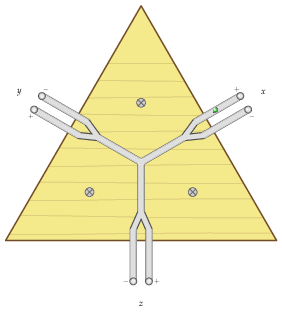
When you make a repeat measurement, by resetting the board to the level position and tipping it the same way, you get the same outcome, as the ball is trapped.
When you perform a new measurement on a different axis, the ball is elevated above level, escapes the trap, rolls to the center, rolls down the next axis, and again goes randomly into one of two traps after hitting a fork.
This shows several features of a qubit system: there are two possible outcomes for any given axis; a measurement is performed in a chosen basis; changing the basis and performing a new measurement does not preserve the previous state. E.g., performing a \(y\)-measurement after an \(x\)-one destroys whatever \(x\)-state it was in. Repeat measurements, though, give the same outputs. These are features of projective measurements that disturb the state and are repeatable.
You can see the board as a classical hidden-variable-style analogy for measurement outcomes on a qubit state. The outcomes appear probabilistic to us because of our ignorance of microscopic details of smoothness of the pipes, the speed of the ball, the exact way we tip the board etc. If we knew them all, though, we could in principle apply classical mechanics and figure it out. If this were used in a classroom demonstration, it could be used to contrast classical ignorance and genuine quantum behaviour.
It does not show, and cannot show, interference, entanglement or superposition, however. Why not? The ball goes through a single path, a single fork. There's just no way for a ball to classically go through a superposition of two routes. Thus, this kind of mechanical model cannot be extended to cover multi-qubit correlations, as shown by Bell-type inequalities.
Tags: quantum-mechanics
Is QBism Bayesian?
I've been exploring QBism, an interpretation of Quantum Mechanics (QM) based on or inspired by Bayesian inference. The appeal being that mysteries about the ontic or epistemic nature of the wavefunction and about the collapse of the wavefunction could be resolved in this perspective.
I found it confusing and incoherent. There is nothing mathematically Bayesian about it. We don't describe beliefs with probability theory alone, as we use a wavefunction, and we don't update them using Bayes' theorem alone, as we need the Born rule. It is, though, Bayesian in spirit, in that the wavefunction is interpreted personally and epistemically: it isn't real or ontic, it something that we create in our heads to describe a quantum state. The collapse of a wavefunction isn't real either, it's just an update we do in our heads, analogous to Bayesian updating from prior to posterior. In later works this is explicitly stated and the B is said to stand for Bruno de Finetti rather than Bayes, as much like de Finetti said that probabilities didn't exist, QBism says wavefunctions don't exist in a physical, ontic way.
Sounds wonderful at first glance, until you ask a few more questions. Why are we using wavefunctions to describe our epistemic state (cf. probabilities)? Why do we use the Born rule to associate probabilities with outcomes? If the wavefunction is epistemic, what is it that we are ignorant about? If the measurement and update are all in our heads, what determines which random outcome we observe?
I found the answers to these questions vague and handwavy, as they involve 'agents', 'agent experiences', and 'normative rules'.
Tags: quantum-mechanics, bayes
Quantum Mechanics In Your Face For Anybody
Wrote a lecture on Quantum Mechanics for a non-mathematical audience [pdf]. There are no equations and little maths beyond percentages. The key conceptual differences between Quantum and Classical Physics are there, though, and these topics require attention and serious thought.
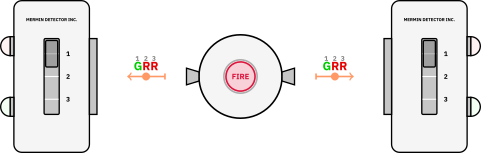
The title alludes to two wonderful expositions of quantum mechanics by the masters:
-
Bringing Home the Atomic World: Quantum Mysteries for Anybody
N. D. Mermin
Am. J. Phys. 49, 940–943 (1981)
DOI: 10.1119/1.12594 -
Sidney Coleman’s Dirac Lecture “Quantum Mechanics in Your Face”
Sidney Coleman
e-Print: arXiv:2011.12671 [physics.hist-ph]
YouTube: Sidney Coleman, Quantum Mechanics in Your Face (1994)
Mermin and Coleman are both physicists' physicists: they aren't widely known to the public, but they contributed tremendous insight and clarity. Feynman described Mermin's paper as "one of the most beautiful papers in physics."
If everything goes to plan, I'll deliver the lecture at least three times this autumn to a general audience, and perhaps use the material when I deliver the PHY301 Quantum Mechanics module, as well, which, if you're interested, follows Griffiths.
Comments, discussion and feedback are welcome, but in the original, small net way. Shoot me an e-mail. I'll be happy to hear from you, dear reader.
Tags: quantum-mechanics, physics