AI tipping points
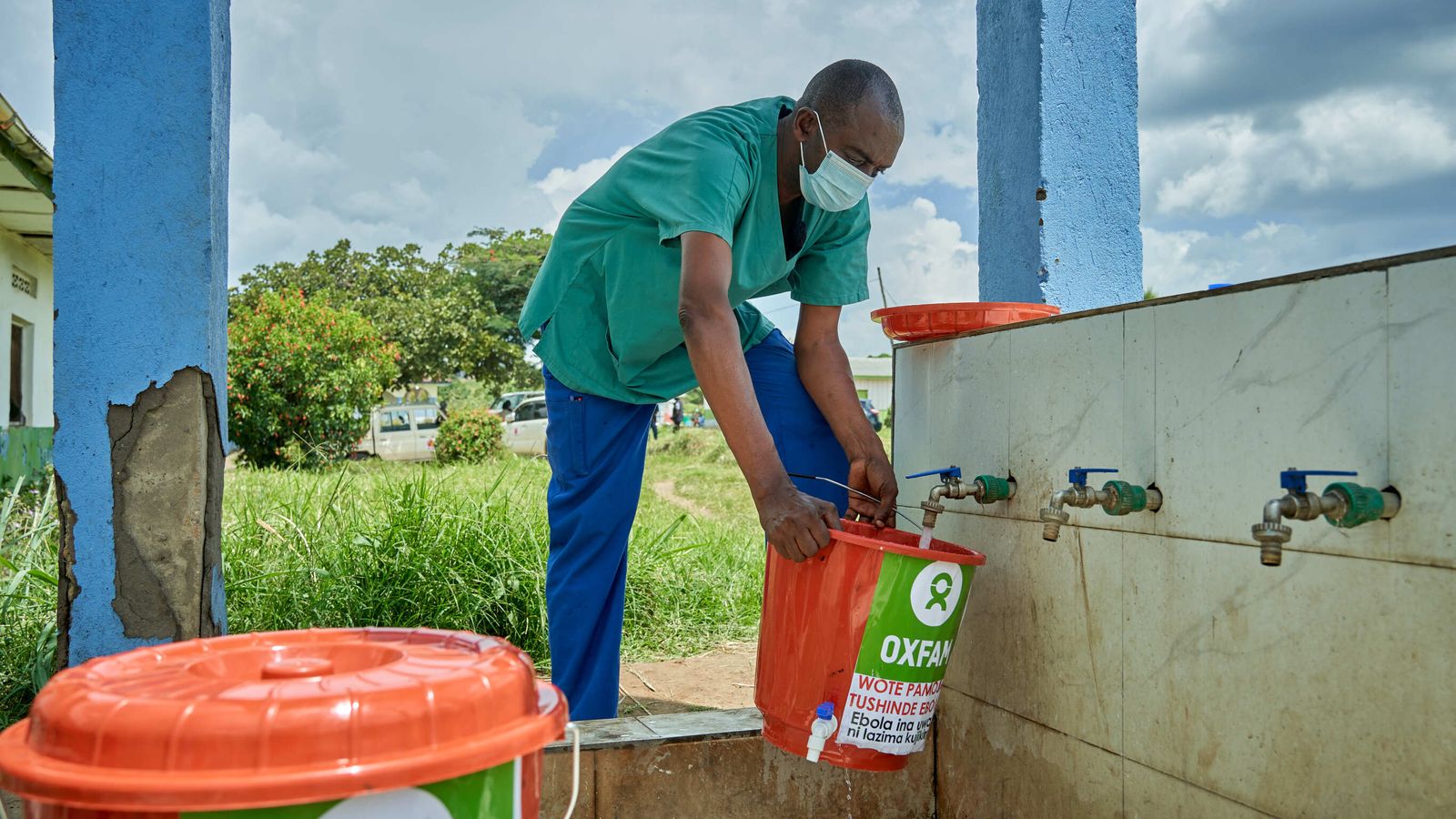
Read a disturbing article about an outbreak of the Ebola virus in the DRC. The causes include a lack of clean water and sanitation facilities, i.e., clean toilets and sinks. At the same time, an AI bubble created a trillionaire and the rapid construction of water-guzzling data centers. We don’t need to solve intelligence and then solve everything else, the stated goal of Demis Hassibis of DeepMind. We need to redress poverty, inequalities and dire circumstances starting now. A long-term benefit of AI is that it’s radicalizing society and making us realize that there are different visions of our future and different ideas about what constitutes progress. AI caused our economic system to descend into an absurd caricature. First tragedy, then farce, as we were warned.
Another tipping point may be happening in academia. For the last few years, researchers have jumped on the bandwagon of AI for science, promoting hype that AI will accelerate scientific progress. This is reflected in academic literature, conferences, personal statements and webpages, and grants. From what I can tell, the bandwagon is now full. AI-scientists are ten a penny. Insights and lasting advances remain rare, and the actual expertise and value of AI scientists, in many cases, looks threadbare.
Only time will tell, but for now I am happy to ying while everyone else yangs. Paradoxically, as a consequence of the rush towards AI, actual understanding of statistics, statistical reasoning, statistical computation, and reasoning under uncertainty in general are at present rare and underdeveloped. I remain interested in AI, but through the perspective of traditional statistics and computing, and with a critical eye on who made it, how and why, and what harm it might cause.
Nanjing
Visited Nanjing for the 2026 Workshop on New Physics and Interdisciplinary Sciences. It was a pleasure to discuss physics with new and old friends. I spoke about forthcoming work on the axion quality problem; a nice work to discuss as it has a clear narrative. Nowadays I try to tell a compelling story about our research - why we did it, how we think about the problem, what we found and why it matters - rather than a complete technical exposition of the work.

A personal highlight was a chance to revisit Stone Elephant Road, a path lined with huge stone sculptures of horses, elephants, camels and dragons to guard a mausoleum.
Delving into focal words on inSPIRE HEP
You've probably noticed that large language models (LLMs) have favourite words that they use more often than human writers. These are known as focal words and the phenomena of focal words is non-trivial. 2412.11385 call it 'the puzzle of lexical overrepresentation'.
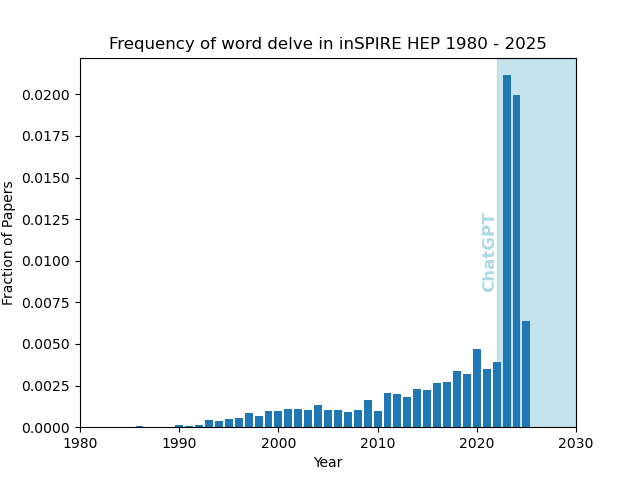
I thought I'd check out the appearance of a focal word in the high-energy physics literature by querying the inSPIRE HEP database. I use the 'fulltext' search and looked at the word 'delve'. I think this does some kind of stemming so that, e.g., 'delve' also matches 'delving'. I normalized the results to the total number of papers per year. The results are:
Of course, authors could be influenced by LLMs or imitating 'good' writing produced by LLMs. I don't know much about this field. Make of it what you will.
I can understand the spike, but I'm not sure why it decreased back down in 2025. Perhaps LLMs have evolved and 'delve' isn't such a common focal word anymore? Perhaps writers are conscious about hallmarks of LLMs in their work and edit instances of 'delve'? Perhaps 'delve' was a buzzword that entered popular consciousness because of LLMs?
The Church of Reason
Reading Zen and the Art of Motorcycle Maintenance. I didn't expect so much relevance to academia (though new little about the book):
The real University is not a material object. It is not a group of buildings that can be defended by police. He explained that when a college lost its accreditation, nobody came and shut down the school. There were no legal penalties, no fines, no jail sentences. Classes did not stop. Everything went on just as before. Students got the same education they would if the school didn’t lose its accreditation. All that would happen, Phaedrus said, would simply be an official recognition of a condition that already existed. It would be similar to excommunication. What would happen is that the real University, which no legislature can dictate to and which can never be identified by any location of bricks or boards or glass, would simply declare that this place was no longer “holy ground.” The real University would vanish from it, and all that would be left was the bricks and the books and the material manifestation …
The real University, he said, has no specific location. It owns no property, pays no salaries and receives no material dues. The real University is a state of mind. It is that great heritage of rational thought that has been brought down to us through the centuries and which does not exist at any specific location. It’s a state of mind which is regenerated throughout the centuries by a body of people who traditionally carry the title of professor, but even that title is not part of the real University. The real University is nothing less than the continuing body of reason itself.
Tags: reading, academia, philosophy